-
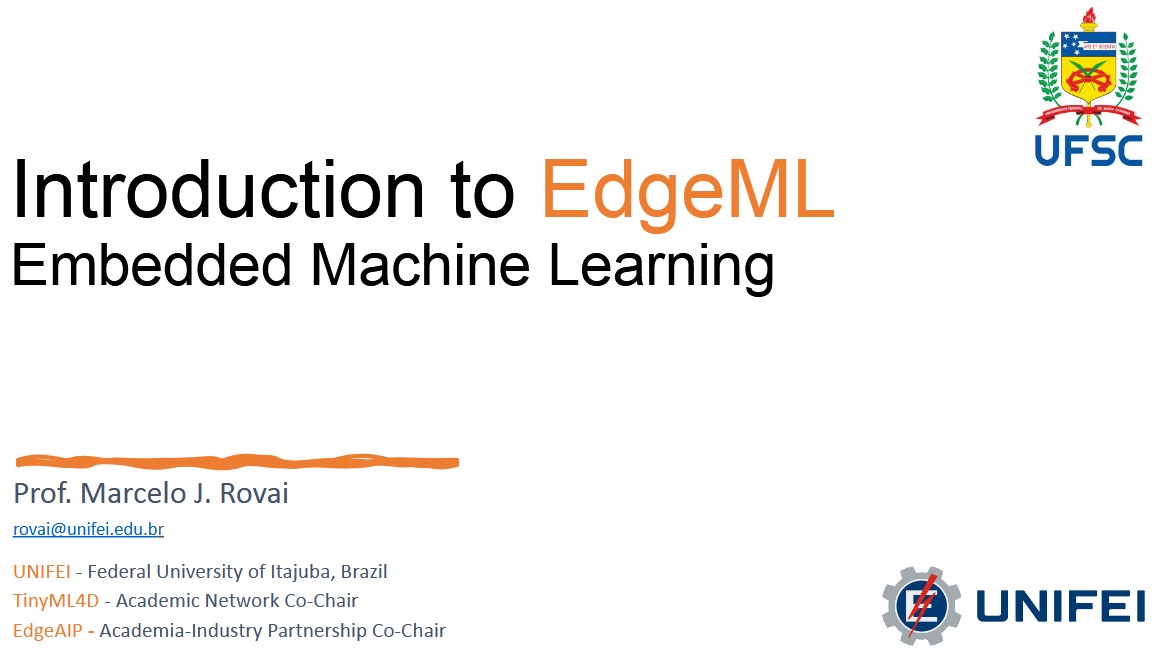
Inaugural lecture with Prof. Marcelo Rovai on EdgeAI
This Thursday, 08/14, at 10 AM, we will have a brilliant lecture with Prof. Marcelo Rovai about Edge AI. This lecture will be the inaugural class of my course Edge AI.
The lecture is open to the public, just access the linkhttps://lnkd.in/djyKcvYB
-
(Português do Brasil) LPA-Laboratório de Pesquisa Aplicada está mudando de nome
The LPA – Applied Research Laboratory is changing its name. It will now be called the Cyber-Physical Systems – CPS-Lab. Let’s understand what a cyber-physical system is. Cyber-physical systems (CPS) are integrations of computational components with physical processes and elements that interact in real time. They combine hardware, such as sensors and actuators, with software and communication networks to monitor, control, and automate physical systems through intelligent algorithms.
These systems are capable of collecting data from the physical environment, processing it digitally, and acting on that environment automatically and precisely, closing the loop between the digital and physical worlds. Examples include robotics, industrial automation, autonomous vehicles, smart grids, and connected healthcare systems.
In practice, CPS enable simulations, continuous monitoring, maintenance prediction, and decision-making based on reliable data, driving advancements in Industry 4.0, the Internet of Things, and other sectors that depend on the interaction between the physical and digital.
Why did the name change?
The name LPA was always very generic and did not reflect the research conducted in the laboratory. CPS-Lab clearly represents the research being carried out, so knowing the name and what CPS means makes it easy to understand the laboratory’s focus.What else will change?
The team is the same, the equipment remains the same — in other words, the entire infrastructure stays unchanged; only the name is being updated to better identify the laboratory. The laboratory’s lifespan and research activities will also continue as before. -
LPA launches a portal with 3 meteorological stations for access by the entire community
The portal, https://clima360.lpa.ufsc.br/, with data from 3 meteorological stations in the cities of Araranguá, Santa Rosa do Sul, and Alpestre, was launched starting in November 2023. The first two are located in the state of Santa Catarina, and the last one in the state of Rio Grande do Sul, Brazil.
The data is provided by professional meteorological stations, stored in a database, and reports can be generated from this data. The website is hosted on the LPA server and is available 24/7 to the entire community.
You can find a video tutorial on how to access the data and generate reports at this link: https://drive.google.com/file/d/1HkJ2kdf4yrSb8SsX2Q-mFVaxe-AZzdnq/view?usp=drive_link

-
Master’s degree Douglas Waltricke Freitas. Title: METHODOLOGY FOR PREDICTING THE IDEAL TIME FOR PRUNING IN TREE REGIONS.

-
(Português do Brasil) Resultado da seleção bolsa PIBE 2023
-
(Português do Brasil) Edital de seleção bolsa PIBE
-
Master’s defense by academic Wellington Fernandes Silvano “IOTA distributed logging and SIGFOX connectivity as a solution for secure traceability and monitoring in the supply chain”
On August 17, 2021, we had the defense panel of academic Wellington Fernandes Silvado's master's thesis whose title was, IOTA distributed registration and SIGFOX connectivity as a solution for traceability and secure monitoring in the supply chain

-
Master’s defense
In this month of April 2021 we had two master's defenses. Both happened remotely due to the restrictions of the pandemic.

1. Rodrigo Cesar Nunes Maciel. Prediction of Chlorophyll Content in Irrigated Rice Culture Using Images
Aerials and Artificial Neural Networks.
2.Juliano Oliveira de Almeida. Methodology for technical and scientific evaluation of blockchain applications: a case study in the electricity sector
-
Paper is chosen as the best paper of the month by the journal Future Generation Computer Science-FGCS
Elsevier’s FGCS journal chose the paper “Iota Tangle: A cryptocurrency to communicate Internet-of-Things data” as the journal’s article of the month. The journal has a high global impact and shows the quality of the work carried out by our master’s program in new information and communication technologies.